I'll be honest: y'all were blowing through the tech tree in about a week. I watched it happen. Convert two hundred villagers into scholars on day three, point them at the thirteen techs that lead to the Golden Age, and you were done before the month was out. A traded technology showed up free and instant, which made it worse. None of that was the plan, so ruleset 33 is me fixing the plan. Research is now something you build, plan for, and pay for — and getting from the Stone Age to the Golden Age should take you a good chunk of a season.
A world keeps the ruleset it was born with, for life. Everything on this page applies to worlds created at ruleset 33 or later. If you're on 32 or earlier, nothing changes under you. Promise.
Scholars need somewhere to work
A city now has a limited number of productive scholar slots: five with no knowledge building, ten with an Ancestor Shrine, twenty with a Scriptorium, thirty-five with a University, sixty with a Great Library, plus ten each for a Grand Temple and a Monument. You can still assign more people than that, but only the ones with a desk actually count. The People panel shows your slots and tells you which building would give you more.
This is the change that matters most. The old way to research fast was to empty your farms into the library. The new way is to build the library — which means research now competes with everything else for lumber, cut stone and gold. That's how it should have worked from the start.
You finish an age, you don't skip it
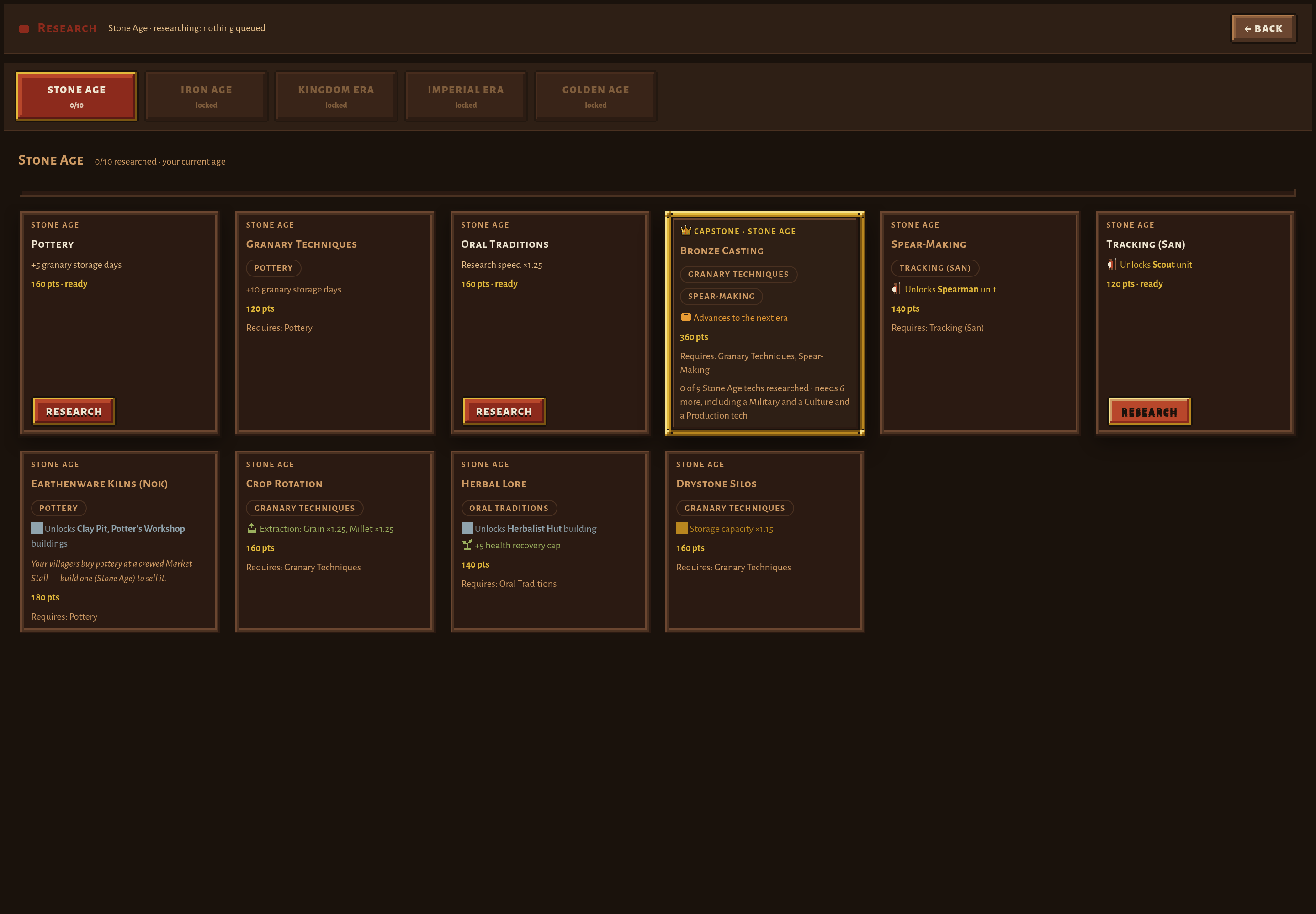
Each age's capstone — Bronze Casting, Centralized Rule, Kingdom Chronicles, Imperial Annals, Legendary Reign — now wants sixty percent of that age researched, with at least one tech from every branch the age has. The card counts it down for you: "6 of 9 Stone Age techs researched · needs 1 more, including a Military tech." The shortest road to the Golden Age was thirteen techs. It's forty now.
Costs climb with the ages too. Tech prices are multiplied by 2 in the Stone Age, 6 in the Iron Age, 13 in the Kingdom Era, 15 in the Imperial Era and 21 in the Golden Age, and every capstone costs twice the dearest ordinary tech of its age. I also went through the prerequisite chains — most techs used to have none — so each age reads as two or three lines of development instead of a pile of things to buy in any order.
Trades cost scholar-days
Accepting a traded technology no longer drops it in your lap. It becomes your queued research with half the cost already paid, and your scholars finish the rest. The trade is still the knowledge — no prerequisites needed — but it goes through the same queue as everything else. If you're already more than halfway through a study, the offer is refused as busy; finish first. If you've just started one, accepting replaces it and your banked points carry over.
Goods, or gold
Twelve technologies from the Kingdom Era onward consume goods when you queue them: leather for Royal Scribes, salt for Praise Songs, gold ingots for a Gold Standard, carved ivory for the Golden Libraries, and so on. The goods come out of your capital's stockpile. Don't have them? Buy them on the market — or pay gold at twice the base price, right there on the card. Goods are the cheaper road. Gold means no tech can ever be locked away from you just because your land doesn't have leather.
Some knowledge has to be earned
Seven techs ask you to do something first. Fight a battle for Formation Warfare. Run a trade route for Bronze Trade Routes. Hold two territories for Royal Roads, own a hills territory for Terrace Farming, three territories for Provincial Governors, build a Harbor for Naval Warfare, hold a Trade treaty for Trade Compacts. None of these sit on the road to an age's capstone, and every deed is waived after 200 days in your current age — the card shows the deed and the countdown. A peaceful, landlocked kingdom gets delayed, never blocked.
Research opens sooner
The Research window unlocks when your villagers' intelligence hits eighty. That used to take about eighty days at 8% scholars. It's about ten now, because on a slower world eighty game days was a full real day before a brand-new player could research anything at all. That felt bad, so I fixed it.
What the pace looks like
I ran a five-thousand-day test with a kingdom that keeps its knowledge buildings current and never lets its scholars sit idle. The ages fell around day 250, 930, 1,900 and 3,100, with the last tech landing near day 4,800. The AI kingdoms, who play by every rule above, hit the Golden Age around day 3,500. Ruleset 33 is built for worlds that run fifteen to thirty minutes per game day, where that arc is one to two months of real time. The day length gets set per world when it's created.
Smaller changes
Research points banked while nothing is queued are capped at the cost of the dearest tech in your current age. The Kingdom panel shows the bank and tells you when it's pinned.
The six techs that multiply your research rate now form one chain, so researching a lower one after a higher one can't drop your rate anymore. (Yes, that was possible. Sorry.)
AI kingdoms put a quarter of a city's people into scholar slots where they can, so they keep up with the new tree instead of stalling out in the Imperial Era.
When a tech completes and nothing is queued, the dispatch says so: "your scholars are idle." No more staring at a number wondering why it stopped.
What it means for you
| Change | What it means for you |
|---|---|
| Scholar slots | Build a Shrine, then a Scriptorium, before you convert more villagers. Assigning past the cap just empties your farms. |
| Breadth | Plan an age, not a beeline. The capstone card tells you exactly what's missing. |
| Goods or gold | A trade partner who sells leather and salt is worth more than one who sells grain. Failing that, keep a treasury. |
| Trades | Buying a tech is still worth it — it halves the work — but it takes your queue, so time it. |
Known issues (still open, still mine)
A capital left untouched runs its food to zero around day ninety and stays there. Idle villagers won't fill empty farm slots on their own. Staff the farms by hand and you're fine.
Kingdoms, yours and the AI's, stay on one tile far longer than I intended. Mustering a settler party is a deliberate act, and with per-city scholar slots a second city matters more than it used to.
AI kingdoms list goods but rarely sell them, so the goods a later tech wants may not be on the market when you need them. The gold price exists for exactly this. I'd rather the market just worked, and that's next on my list.
If you hit something else, note the game day and what you'd just done. That pair is almost always enough for me to reproduce it.
Peace,
Yadah