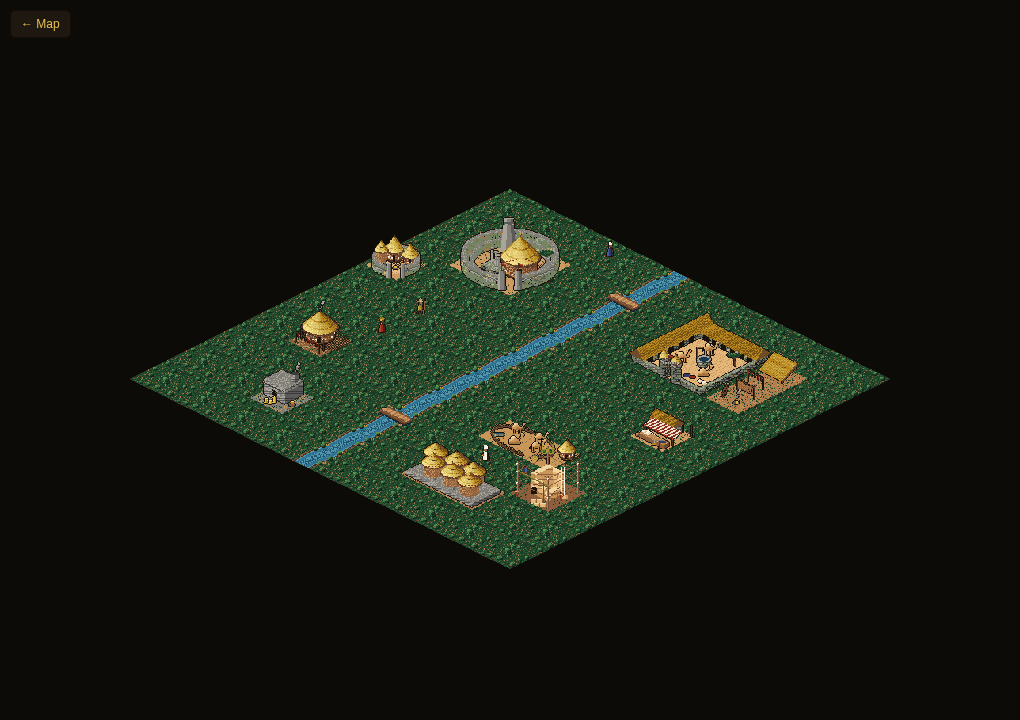
Here's a confession. For a long time luxuries in this game did almost nothing you could see. Your people quietly helped themselves to whatever was in the store, the only reward was a small bump to births, and nothing on the screen ever said "your people want pottery." So most of y'all ignored luxuries entirely, and honestly, fair enough. Ruleset 36 fixes that. Your people now buy their comforts at the market stall, you can see exactly what they want and whether they're getting it, and a happy town works harder the same day. Two smaller rulesets shipped on the way here, and there's one change that reaches every world, old and new: you can finally declare war without marching on anyone.
A world keeps the ruleset it was born with, for life. The shopping, the two kinds of wants and the happiness payoff are ruleset 36, so they apply to worlds created at 36 or later. The tribute fix is ruleset 34 and the market clean-up is ruleset 35. If you're on 33 or earlier, none of that changes under you. Promise. The one exception is the Declare war button: that one is on every world, today. I say why below.
The stall is the shop
Your people now buy luxuries in one place only: a market building with people working in it. A Market Stall sells up to 4 luxuries a day with its full crew of three. A Market sells 12, a Grand Bazaar 24. An empty stall sells nothing, and a half-crewed one sells about half. No crewed stall, no sales — the pottery just sits in your store.
You don't need any research for this. The Market Stall is a Stone Age building, three wood, buildable from day one. So the whole chain — Pottery, then Earthenware Kilns, a Clay Pit, a Potter's Workshop and a stall — fits inside the Stone Age.
Each person wants about a hundredth of a luxury a day, so a town of a hundred wants roughly one a day and one stall comfortably serves a couple of hundred people. When your people want more than your shops can sell, everybody gets the same share. Nobody goes to the front of the queue because of their job.
Everyday goods and fine goods
Not every luxury is equal anymore. Pottery, millet beer and woven cloth are everyday goods: ordinary people expect them, and going without makes a town unhappy, the same as it always did. Everything else — gold ingots, carved ivory, spices, camel gear — is a fine good. Fine goods only ever help: meet that want and happiness climbs by up to ten points, miss it and you lose nothing.
Your people buy everyday goods first. Fine goods get whatever shop room and spending money is left over. So a town full of gold and no pottery is still an unhappy town. That's on purpose: I want the humble potter to matter more to your people than the mint does.
A happy town works harder
Until now happiness only nudged your birth rate, which at five real minutes a game day you'd never notice. Now it pays the same day. Take a town's average happiness: above 70, it produces more and pays more tax, up to 15% more. Below 55 it's grumbling, and you lose up to 15%. Anywhere in between, nothing changes.
Roughly: everyday wants met is worth about +10%, everyday and fine together about +15%. A fed town with no luxuries sits at the steady middle, so a town without pottery loses nothing it had before. Food is never affected, in either direction. If hunger could cut your food, a hungry town would feed itself into a famine, and I'm not doing that to anybody.
You can see it now
Open a city and go to the Workers tab. There's a new block right under the population line: how much of the everyday and fine wants are being met, what your stalls can sell against what your people want, whether the town is content or grumbling and what that's costing or earning you, and your growth now against your growth with everyday wants met. When the stalls can't keep up, it tells you to build another one.
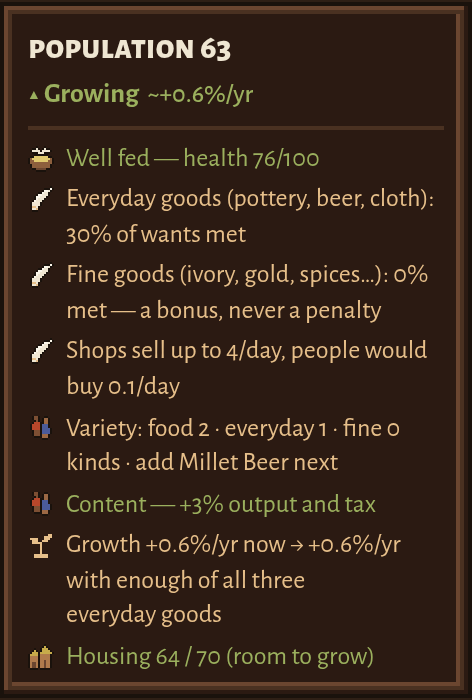
The bell has three new dispatches: your stalls are selling, your stalls sold out with goods still in store, and a town has started grumbling. (A fed town doesn't grumble just for want of pots. If you get that one, check its food first.) The Market Stall's description in the build menu now says what it's for — "Lets your villagers buy everyday goods and luxuries" — and the Potter's Workshop, Brewery and Weaver's House, plus their research cards, all tell you their goods sell at a crewed Market Stall.
One more thing, and this one's on me. The Iron Age technology called "Market Stalls" never unlocked market stalls. It unlocked the Market. Even I got caught out by that name. It's called "Marketplaces" now, on every world. Nothing about what it does has changed, just the name.
What I broke on the way
Before anything ships I run a five-thousand-day simulated world and read what happened. The first run of ruleset 36 was bad. One AI kingdom got stuck in the Kingdom Era with 42 of 79 technologies, where it normally reaches the Golden Age.
Two things had gone wrong. First, the AI crews its market stalls last, so its small towns ran out of people before any stall got a worker, and nothing ever sold. Second, a new town starts with its people at happiness 65, and my first version started the penalty at anything under 70. So every town in the game opened with a hidden production penalty. That shaved a little food off everyone, and the AI pulled workers onto its farms to cover it.
Both are fixed. Once the AI has something to sell, its first stall now gets workers right after the farms, and it adds more stalls, up to eight, when its people want more than its shops can move. There's the no-change band between 55 and 70, and food is exempt. After that, the same AI reached the Golden Age with 78 of 79 technologies. None of it ever reached a real world — this is exactly what the long test run is for.
You can declare war
Until now the only way you could start a war was to march an army onto somebody's city. The AI has always been able to declare war properly. You couldn't. Now every rival's row in the diplomacy panel has a red Declare war button, hidden while you're already fighting them.
Before you commit, the confirm box names every treaty the declaration will tear up and how far relations will fall. Declaring breaks every active treaty with that kingdom at −30 relations each, on top of −40 for the declaration itself. Then the war starts on the spot: both sides get the dispatch, and wartime rules apply straight away instead of when your troops arrive. A war still ends only in a peace the other side agrees to.
This one is on every world, old and new, the same call I made for halting armies. No saved game can hold a declaration that was never possible, so turning it on can't change anyone's history. It just gives the button to the kingdoms that were already playing.
Tribute has to be paid (ruleset 34)
A vassal that pays you tribute is worth eight points of your victory score. The problem was that a completely broke vassal, one that paid you nothing at all, still earned you those eight points forever. The game gives a broke vassal thirty days of grace before it asks again, and the score was reading that grace period as a payment. The "tribute paid" dispatch was fooled the same way.
From ruleset 34 the bonus counts only if gold actually moved in the last thirty days. A single vassal that really pays you is still worth 22 points; one that can't pay is worth 14. So a rich vassal is finally worth more than a bankrupt one, which is how it always should have been.
A dead kingdom stops selling (ruleset 35)
When a kingdom died or lost a city, everything on that land was wiped — people, goods, prices — except its standing sell orders and export floors. Those stayed on the empty ground, and whoever settled there next inherited them. Because a respawn tends to land where a kingdom just fell, a fresh capital could arrive with its starting supplies already listed for sale at a dead player's price. From ruleset 35 those orders are cleared the moment the land changes hands, however that happens.
Smaller changes
Right of Passage now says which way it runs. Proposing it asks to cross their land; accepting an offer opens your borders to their armies. Before this, accepting looked like you were getting something when you were actually giving it.
The build menu tells you what a commerce building earns — "Adds up to +5% daily wealth, fully crewed" — instead of just how many workers it holds.
Kingdom names can't contain angle brackets or equals signs anymore. If yours is refused, that's why, and the message says so.
What it means for you
| Change | What it means for you |
|---|---|
| Stalls | Build a Market Stall early and put three people in it. Without one, every pot you make just sits there. |
| Everyday goods | Pottery first. It's the cheapest chain in the game and the one your people care about most. |
| Happiness | Watch the mood line on the Workers tab. A content town is worth up to 15% more of everything but food. |
| War | You can declare it now. Read the confirm box — it tells you exactly which treaties you're about to break. |
| Vassals | A vassal that can't pay is worth 8 fewer points. Take a rich one if you can. |
Known issues (still open, still mine)
A capital left untouched still runs its food to zero around day ninety and stays there. Idle villagers won't fill empty farm slots on their own. Staff the farms by hand and you're fine.
Kingdoms, yours and the AI's, still stay on one tile far longer than I intended. Mustering a settler party is a deliberate act — do it on purpose.
AI kingdoms still list goods but rarely sell them to you. I said last time it was next on my list. It's still on the list. I'm sorry.
A stall looks the same whether it's stocked, empty or sold out. Read the Wants block on the Workers tab until the art catches up.
The panel says which way a Right of Passage runs, but the dispatch for a new offer still doesn't. Check the diplomacy panel before you accept one.
If you hit something else, note the game day and what you'd just done. That pair is almost always enough for me to reproduce it.
Peace,
Yadah