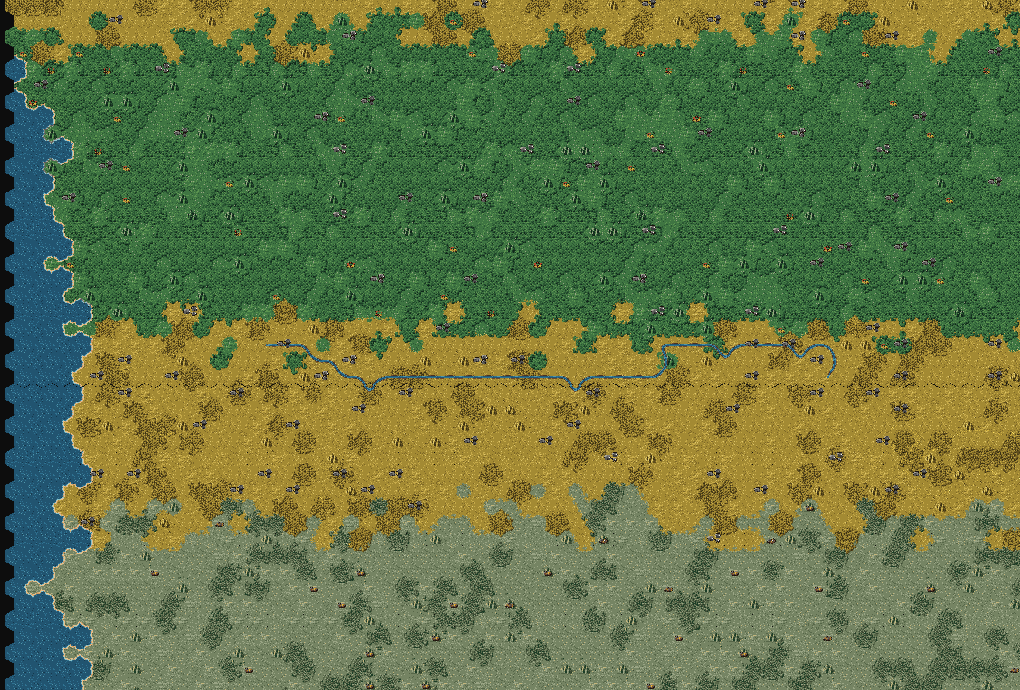
I sat down to play my own game properly and found out what some of you already knew: it is very hard to grow your population. A perfectly run city, farm full, huts built, everyone fed, gained about one new person every 25 to 50 real minutes. That was never the plan. So ruleset 42 is a balance pass on growth, hunger, housing and the computer kingdoms, and ruleset 43 is what comes next once growth works: people who are badly off leave, and research depends on how your people live. Ruleset 41 slipped out in between without a post, so it gets its paragraph here too.
A world keeps the ruleset it was born with, for life. Ruleset 41 is on worlds created from 20 October, 42 from 22 October, and 43 from 23 October. If you are on 40 or earlier, nothing changes under you. Promise. The new lines on the city card and the research card only appear on worlds that have the rule they describe. The guides, the fixed share picture and the server changes are for everyone.
What was wrong with growth
Births were tuned for game years, and a game year is about three real hours on a normal world. A fed, healthy, housed city netted 8 to 10% a year. Put that against the clock and it is one person every half hour or so. Meanwhile the computer kingdoms sat on 200 to 380 food they would never eat, and grew no faster than you did. Food did nothing once everybody had eaten. That is the bit I changed.
Ruleset 42: spare food is the engine
From ruleset 42 a city grows on what it has left over. Make more food than your people eat, or have it delivered by route, and the surplus turns into births. Twenty percent more than you eat is full speed, which is about 70% a game year. Luxuries add up to half again on top. A fed city with nothing to spare holds steady. A hungry city shrinks, as it always did. Food sitting in the storehouse does not count: it is your famine buffer, not your growth engine.
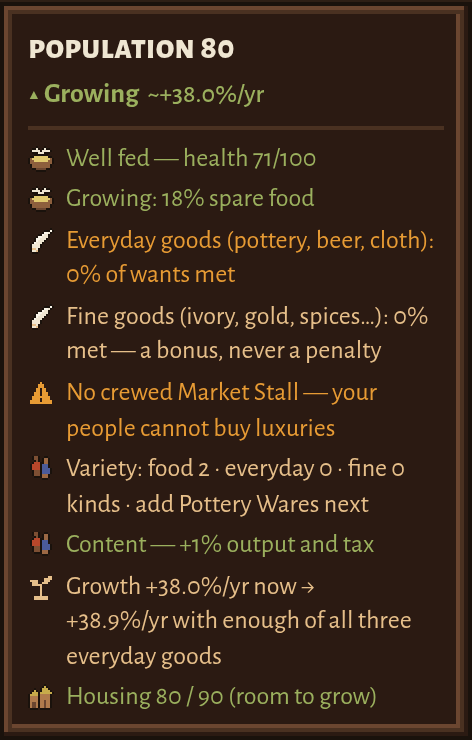
Growth limits itself, which is the part I like. Every newborn eats, so the spare shrinks as the city grows, and growth slows to a stop as the farms fill up. Staffing another farm, or building one, is how you keep going. In my test worlds a well-run city went from 65 people to 258 in a thousand days. On the old rules the same city reached 80. (I first set full speed at 35% a year, watched a well-run city sit at the ceiling, and doubled it. If it feels fast now, tell me.)
Overcrowding bites now
Before, people past your housing just showed up as a number. Now they cost you. Past the housing limit growth slows, half speed with one in ten unhoused, and real health and mood fall, 12 points of health and 16 of mood at that same one in ten. Huts are cheap. Build them before the card turns orange, not after.
A new city starts fed, and a coastal start keeps its storehouses
Two things were wrong on day one. The first: your starting farm had 15 of its 30 places filled, which fed 37 people in a city of 65. If you did not touch it, your capital starved from 65 down to about 28 while you were offline. The tutorial did say to fill the farm, but the world keeps running whether you read the tutorial or not. A new city now starts with 26 on the farm, which is exactly enough to feed everyone and not a mouthful more. Growing is still your job.
The second: about one join in nine landed on a coast where the sea covered the squares the starting buildings were always placed on, so some or all of the four Storage Areas and the farm were simply missing. With no storage, the starting wood, stone and food counted as overflow and rotted away in about fifteen days, and nothing a logging camp made could ever pile up again. The city was dead before you had done anything wrong. (Yes, that was possible. Sorry.) Starting buildings, and a new colony's storehouses, now go on the first free land. In 160 test joins after the fix, none were missing anything.
Computer kingdoms that actually settle
A settler party costs 20 gold. The computer kingdoms started with none, so most of them never settled anywhere: in sixteen runs of 1,500 days the merchant, cautious and warlord kingdoms founded exactly zero colonies. The expansionist did, but picked sites by distance with no thought for food, and a colony on land with no grain, millet or cattle starved out about 340 days after founding. Four of twelve colonies died that way.
They start with 20 gold now, they only settle where there is food in the ground, and a kingdom under three cities settles before it staffs. In the test worlds every computer kingdom held three or more cities by day 250 and no colony was lost. Your neighbours are going to be bigger than you are used to. Plan for it, or trade with it.
The Mill was throwing away half your grain
The Mill turned two grain into one flour. Grain and flour are both one meal. So milling halved your food, and I had been wondering why nobody built one. It is one to one now. The Smelter turned three iron, worth 36, into one steel, worth 25; only two computer kingdoms in nine ever made steel, and I do not blame them. It is two to one now. Spoilage takes raw goods first and refined goods last, so your flour outlasts your grain, and the computer kingdoms stop mining into a store that is already full. The storage caps, the 25% spoilage rate and the per-worker output all stay as they were. I checked, and they hold up.
Ruleset 43: a grumbling town loses people
Until now a miserable city kept every person it had. Unhappiness slowed births a little and that was all. From ruleset 43, people in a class whose mood is under 55, the same line where the card starts saying "Grumbling", pack up and leave the map. One in 500 a day at mood 45, one in 200 at mood 30, never more than one in a hundred. Each class goes by its own mood, so a hungry city's farmers can walk off the farm, and you re-staff it. They take their share of the savings with them. Migration alone never takes a city under ten people.
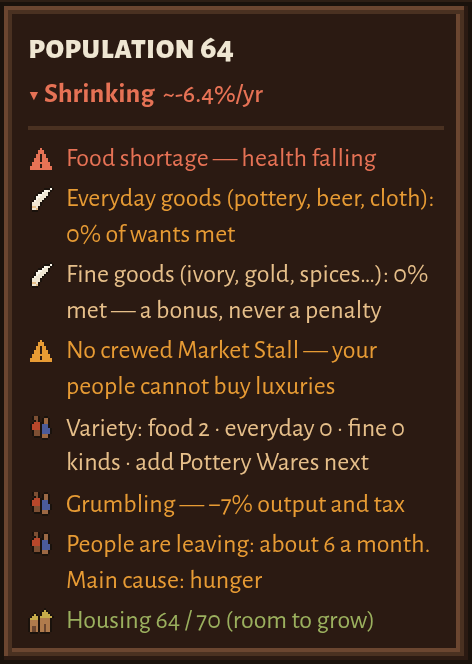
What gets a town under 55 in practice is hunger, real overcrowding, or several smaller things at once: no public works, no everyday goods, and a crowd. A fed, housed city with its works funded sits around 65 to 70 and never sees this. Overcrowding now fixes itself the hard way: the crowd drags mood down, people leave until the city is a few over its housing, and mood recovers. In the test worlds no human city lost anyone. The worst computer kingdom lost thirteen people in a thousand days. A bell rings once when a city starts losing people.
Ruleset 43: a full bar waits for the breakthrough
This one was an idea of mine from back in September. Research cost nothing beyond the villager who became a scholar; a starving kingdom researched exactly as fast as a thriving one. Now the breakthrough depends on how your people live. The Kingdom tab shows a number called kingdom life quality, the average of your people's Quality bars. When a research bar fills, the tech is not done yet. Each day there is a chance the breakthrough comes: 50% a day when life quality is 80 or more, which usually means one to three days; 30% at 60; 10% at the poverty floor of 40, which is about ten days.
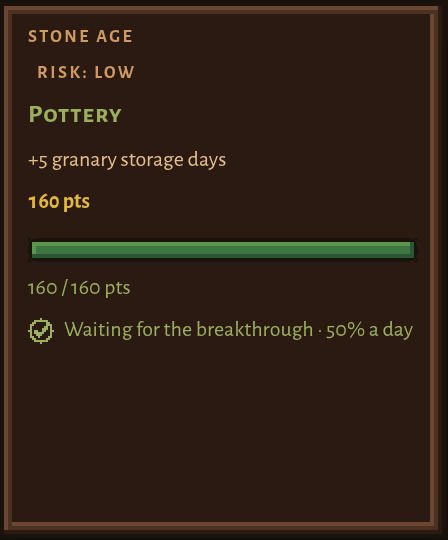
Below life quality 50, which means real hunger or poverty, a day without the breakthrough can bring a setback: a 1% chance a day at 49, rising to 10% at 40, that the bar drops by half the tech's cost, and the bell tells you why. "Famine in Kumbi Saleh scattered the scholars. Pottery lost half its progress." A fed, housed kingdom never sees one; in a thousand test days nobody who was fed did. Points your scholars earn while you wait are not wasted, they carry into the next tech, and if you switch research while a bar is waiting you lose that tech's cost and keep the rest. The computer kingdoms play by the same rule. In the test worlds they finished 466 techs against 467 before, so it is not a brake on the race, it is a reason to keep your people fed.
A computer kingdom only kneels to someone who earned it (ruleset 41)
In the six-player victory test a computer kingdom swore itself to a human on day one, which handed that player 22 victory points for one conversation. Not the plan. From ruleset 41 a computer kingdom accepts your demand to become its overlord only if it adores you, or you beat it in a war. Both are things you have to do. The same ruleset fixed a small lie in the city card: a class with nobody in it used to read as "all wants met", and now reads as nothing met, so a fresh capital no longer looks better supplied than it is. Ruleset 41 shipped on 20 October without a post, because it was two lines of rules and I was already deep in the growth work.
Smaller changes
The Workers card gained three honest lines: how much food you have to spare and what to do when it is none, when you are over your housing, and who is leaving and why.
Every tech card carries its risk tier, a full bar reads "Waiting for the breakthrough" with the day's chance, the Kingdom tab shows your kingdom life quality, and the switch-research warning says what you would actually lose.
Two new bells: a city has started losing people, and a research setback, with the city and the cause.
Your first hundred days, Founding, Staffing and Luxuries now describe spare food, the 26-farmer start, the breakthrough wait and the towns that lose people.
The picture that shows up when you share the First hundred days guide was still the old growth card, which said a fed city could shrink. The guide said it could not. The picture agrees with the guide now.
I ran 1,500 test players across 38 worlds to find out where things bend. A world takes about 40 fresh players before its clock starts falling behind, so the game clock got a bigger engine, and the first shared limit turned up at about 1,250 players, which I now know how to lift. You will not see any of this. The bill does.
What it means for you
| Change | What it means for you |
|---|---|
| Growing | On a 42 or 43 world, fill the farm, watch the spare food line, and build another farm when it reads steady. Build huts before you need them. |
| Day one | A new city starts fed and keeps its storehouses wherever it lands. It still will not grow until you give it spare food. |
| Mood | On a 43 world a grumbling town loses people. Feed them, house them, fund the works, and they stay. |
| Research | On a 43 world a full bar lands in a day or three if your people live well, slower if they do not, and a starving kingdom can lose half a tech. The card shows the risk first. |
| Rivals | Computer kingdoms settle now and feed their colonies. Expect three or more cities each by the first year. |
| Vassals | On a 41 or later world a computer kingdom kneels only if it adores you or you beat it. Pick one. |
| The Mill | It no longer halves your food. Build it. |
Known issues (still open, still mine)
- A computer kingdom can declare war and sue for peace within days, several times over. The peace side behaves; it is the war declaration that should not be happening.
- In a thousand test days no computer kingdom reaches the Kingdom Era, so you will not see their late buildings and units. The research pace for them needs a look.
- A starving city earns more tax, because shortage prices go up and tax is taken on the money that changes hands. Hunger should never look like a good deal on the treasury line.
- A fully staffed Sawmill, Mason's Yard or Smelter can process more than one logging camp, quarry or mine supplies, so some of those workers stand idle. Watch the input before you fill every place.
- The Storage Area text says "50 of any resource". It actually adds 50 room for food and 50 for materials at the same time, which is better than it says.
- One computer kingdom per world stops growing at about 110 people from day 500. I think it runs out of farm places or huts. Not yet checked.
If you hit something else, note the game day and what you'd just done. That pair is almost always enough for me to reproduce it.
Peace,
Yadah