1What you are trying to do
You are not trying to wipe everyone else off the map. You could try, and it would take a very long time, and you would probably lose your own kingdom doing it.
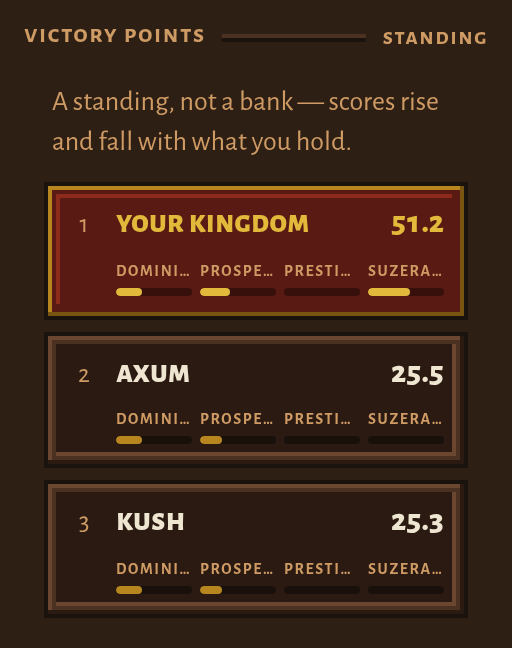
What you are trying to do is become the biggest name in the region — the kingdom other rulers have to take seriously. The game measures that with a score called victory points, and you can see yours any time on the Victory tab.
One thing to understand about that score before anything else: you never bank it. It is not coins in a chest. It is more like a reputation. It goes up while you are strong and it drops the moment you are not. Lose a city and the points for that city are gone the same day. Your score is simply a description of what you hold right now.
2Which world did you join?
Worlds come in two kinds, and it matters a great deal which one you are standing in. You cannot change it later — it is decided when the world is made. The good news is you can see it before you join, on the screen where you pick a world.
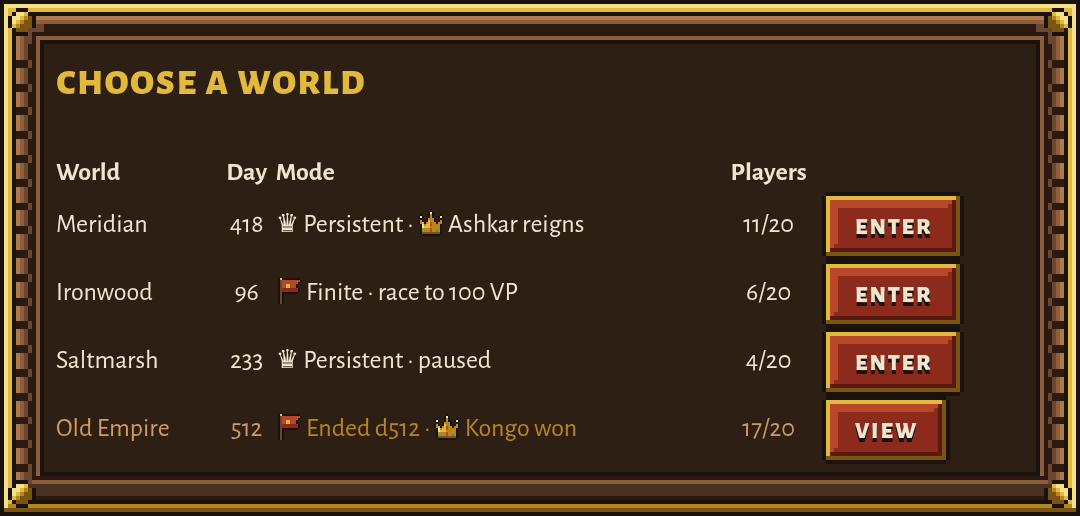
Most worlds are Persistent, and that is the one to start in. There is one difference that will matter to you far more than the ending does: in a Persistent world, if you lose everything, you can start again. Found a new capital, carry on. In a Finite world you cannot. Lose your last city there and your game is over.
3Four ways to matter
Your points come from four different things, and this is the part worth reading twice, because it quietly decides how you should play.
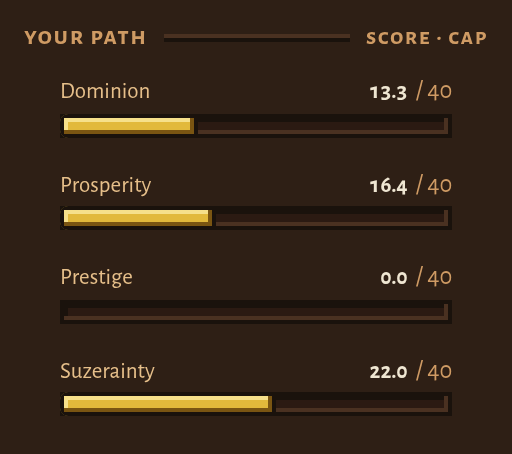
| Where points come from | What it rewards | Most it can give |
|---|---|---|
| Dominion | Holding land — measured against how much everyone else holds | 40 |
| Prosperity | Being rich, and trading beyond your own borders | 40 |
| Prestige | Great works and learning. A finished Monument is 12, and each of the game's fourteen culture technologies is 4 | 40 |
| Suzerainty | Lesser kingdoms who have sworn to you. 14 each, and 8 more from any that has recently paid you tribute | 40 |
Notice that each one stops counting at forty. However brilliant you get at any single thing, it can only ever take you a quarter of the way. Conquer the whole map and land alone still gives you forty. That is on purpose: the game is asking you to be a real ruler, good at several things, not a specialist.
The first two work differently from the last two, and it catches people out. Land and money are judged against your neighbours. If they grow and you merely stay the same, your score falls even though you did nothing wrong. Great works and loyal vassals are yours outright — nobody else's success can take those points away from you.
4The bar, and the long wait
You need 100 points. There is a second way in as well: if you have vassals, their scores are added to yours, and together you need 115.
Then comes the part people are not ready for. Reaching the bar is not enough — you have to stay above it for twenty days without slipping once. Drop below for a single day and the count starts over from zero. This is why a lucky war rarely wins anything. You can spike to 105 by sacking a neighbour, lose the momentum a week later, and have nothing to show for it.
So the real question is not "how do I get to 100?" It is "how do I get to 100 in a way that will still be true three weeks from now?" A conquest you cannot hold, or a fortune you spent to get, will not survive the wait.
If you go the second route, only the kingdoms who answer directly to you are part of your total. Your vassal's own vassals are their business, not yours. So it is better to have three lords sworn to you than one lord with a long tail behind him.
5Where the missing points hide
Here is the trap, and almost everyone falls into it.
Land and money are the parts of the game you are already playing, so those are the paths you naturally push. But they are also the two everyone else is fighting you for, and the two that shrink when your neighbours do well. It is genuinely common to lead the world in territory, wealth and learning, look at your score, find ninety-something, and have no idea what you are missing.
You are missing vassals. A single lesser kingdom sworn to you, paying its tribute, is worth 22 points. Two of them fill that whole quarter of your score. There is nothing else in the game where one conversation is worth as much as a season of war.
Great works are the other place points go unclaimed. There are fourteen culture technologies in the game and each is worth four, so researching ten of them fills that quarter on its own — no armies, no arguments, just choosing them when your scholars are free. If you are stuck in the eighties and cannot see why, this is usually the answer.
6Wearing the crown
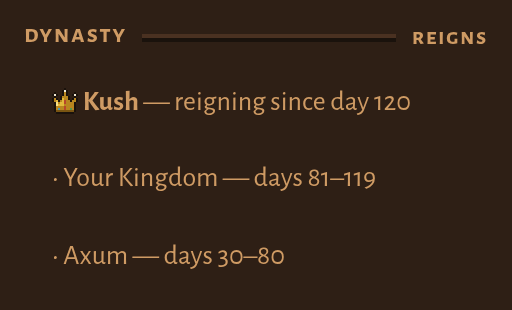
Hold the bar for your twenty days in a Persistent world and you are crowned. A banner goes up across everyone's screen with your name on it and the day your reign began. The world does not stop. Nothing is over. You are simply the one everybody else is now measuring themselves against — and, whether they liked you before or not, the one they have a reason to come after.
You keep the crown until your score falls below 80. Not below 100 — there is deliberate slack in there, so an ordinary bad week cannot knock the crown off your head. And here is the part that changes how you play against a reigning ruler: a rival passing 100 does not take your crown. There is no re-election. The only way to take a crown from someone is to make them weak enough to lose it — push them under 80, and then be ready to step in.
7When a world ends for good
In a Finite world the same twenty days end everything. The ruler who completes the wait wins outright, the world stops on that day, and afterwards anyone who was in it can wander back through and look at how it finished. Nothing more happens there ever again.
There is one other way such a world can end. If every other kingdom has been driven off the map and you are the only one left holding any ground, you win by simply still being there — no score required. You do have to have actually outlasted somebody; being alone in an empty world is not a victory.
Losing your last city in a Persistent world is a bad day. You can start again somewhere else and rebuild. In a Finite world there is no starting again — if a player could keep coming back, the world could never end. So if you play a Finite world, defend your last city as though everything depends on it, because it does.
If you take one thing away, take this. The paths everyone fights over are land and money, and they are the hardest ground to gain because you are gaining it from someone. Crowns are usually won on the two paths nobody is contesting — a couple of neighbours who would rather swear to you than fight you, and a quiet shelf of great works. Those points, once you have them, are yours.