1Why is nothing getting made?
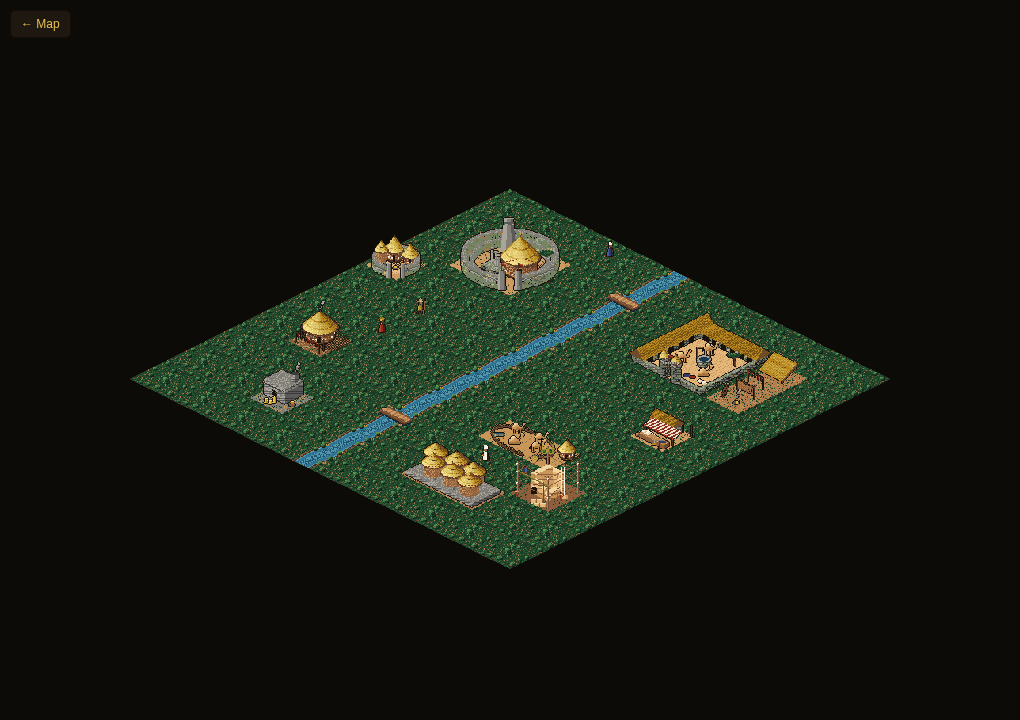
Here is the rule the whole economy runs on: nothing gets made unless somebody is standing there making it. A quarry with no one in it cuts no stone. A market with no one behind the stalls earns nothing. Finishing a building is only half the job — the other half is giving it a crew.
The game will not do this for you. Your idle people are called villagers, and villagers never wander into an empty building on their own. They wait, and they eat, until you tell them where to go.
2How do I put people to work?
Open a city and pick the Workers tab at the top of the panel. The first line is your headcount: villagers in total, how many are working, how many are idle. The idle number is the one to watch.
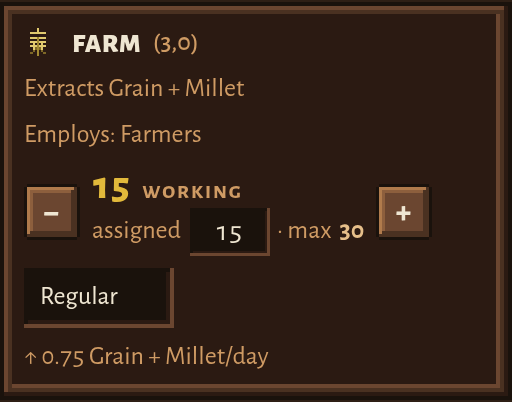
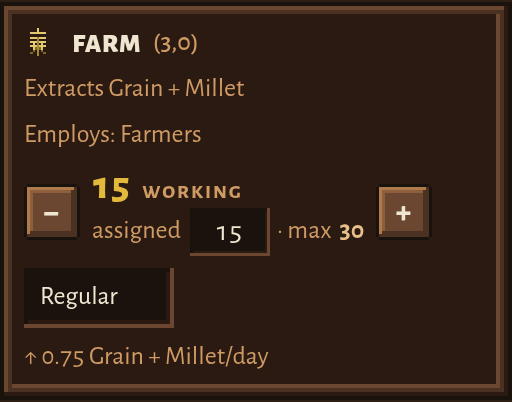
Below that is one row for every building you can staff, with a − and a + button and three numbers between them. The big number is how many people are working there right now. Underneath, assigned is how many you have asked for, and max is how many the building can hold.
Press + and you ask for one more. If there is an idle villager, they start that same day — no waiting, no walking across town. Press − and one worker goes straight back to being a villager. Most of the time working and assigned will match. When they do not, section 7 explains what it means.
3How much does one worker make?
Everybody in this game works at the same steady pace, whatever they are doing. A farmer, a potter and a woodcutter all get through the same amount in a day. The only thing that changes the output is how many people you put in it.
On worlds created from ruleset 36 on there is one more thing: how happy the city is. A contented city, with a mood above 70, gets up to fifteen per cent more out of every building that does not make food, and collects up to fifteen per cent more tax. A grumbling one, below 55, loses up to the same. In between, nothing changes, and food is never affected either way. The luxuries guide covers how to keep people happy.
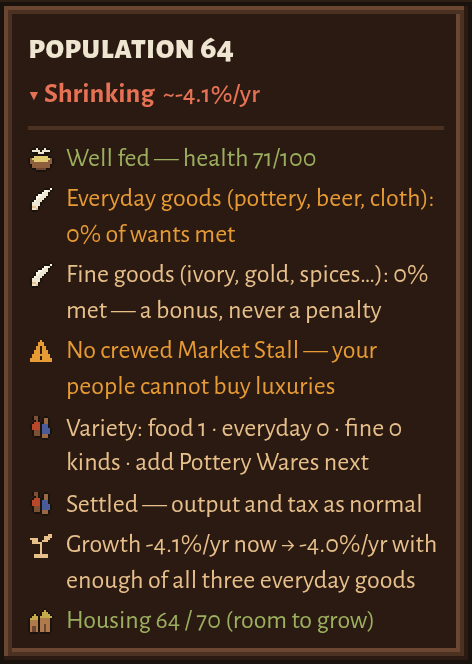
The pace is slow. Twenty people make about one unit of anything per day. A single farmer grows enough to feed two and a half people, so a farm full to its thirty places feeds about seventy-five. In the picture above, sixty-four mouths are living off fifteen farmers. That is why the store is going down.
| Building, fully staffed | People | What you get |
|---|---|---|
| Farm or Ranch | 30 | Feeds about 75 people |
| Logging Camp or Quarry | 10 | One wood or stone every two days |
| Mill or Sawmill | 10 | One flour or lumber every two days — from two grain or wood |
| Clay Pit | 6 | One clay every three days or so |
| Potter's Workshop | 6 | One crate of pottery every three days or so — from two clay |
Notice the pattern. Workshops that turn one thing into another usually use up two of the raw thing for every one they make, so a workshop eats raw material twice as fast as the same number of people can gather it. A full sawmill needs two full logging camps behind it. A full potter's workshop needs two clay pits. Get that wrong and your workshop spends half its life waiting.
Your capital starts with a half-staffed farm and a store of grain to tide you over. That store is not a cushion, it is a countdown. The first thing to do in any new city is press + on the farm until it reads 30. Fifteen extra farmers turn a shrinking town into one that feeds itself with room to spare.
4What do the arrows mean?
Once a building has anyone in it, its row grows an extra line or two. The green ↑ line is what it makes each day at the current staffing. The orange ↓ line, on workshops only, is what it uses up to do that.
The sum is always the same: find the orange ↓ on the workshop, find the green ↑ on whatever feeds it, and make sure the second is at least as big as the first. If it is not, add gatherers — extra hands in a starving workshop just means more people waiting.
5What does the priority box do?
Every row has a little box reading Regular. It does less than it looks like it does. It does not make anyone work faster. It only matters when there are not enough people to go round.
Each morning, the game looks at every building you have asked for more workers than it has, and hands out whatever idle villagers it can find — newborns, or people freed up elsewhere. It fills the Critical rows first, then High, then Regular, then Low. When the villagers run out, the rest wait another day. It never takes anyone away: a Low-priority quarry keeps every worker it has and is only last in line for new ones.
So the honest use of the box is this: set your farm to Critical and leave nearly everything else alone. When your people are stretched thin, food comes first.
6Who counts as a farmer, or an artisan?
Every row says who it employs, and the People tab counts your city by the same names. You do not choose a person's class. It is simply what they become when you put them somewhere, and they turn back into a villager the moment you take them out.
| The name | What it means |
|---|---|
| Villagers | Everyone with no job yet. Newborns start here, and this is the only pool you can staff from. |
| Farmers | Anyone on a farm or a ranch — the people growing food. |
| Laborers | Everyone gathering or making the plain stuff: camps, quarries, mines, the mill, the sawmill, the smelter. |
| Artisans | The people making comforts — potters, brewers, weavers, carvers, the mint. |
| Merchants | Anyone staffing a market stall, market, bazaar, caravanserai or harbour. |
One of those catches everybody out. Markets need staff too. A market stall raises the money your city earns each day, but only in proportion to how full it is. Leave it empty and it raises nothing.
On worlds created from ruleset 36 on, the stall matters twice over: it is the only place your people can buy comforts like pottery or millet beer. A fully crewed Market Stall sells four a day, a Market twelve and a Grand Bazaar twenty-four, and a half-crewed one sells half that. With nobody behind the counter, nothing sells, however much sits in your store.
Scholars are the one class this tab does not handle. They read rather than make, so you set them aside on the People tab, and their work shows up in the Research window, not in any store.
7Why has a row gone orange?
A row can go wrong in two ways, and they look similar but mean opposite things.
The first is a building you have asked for more people than it has. The assigned number turns orange when it is bigger than the number working. That is not a fault in the building — it means you have run out of idle villagers. It will fill by itself as people become free, in priority order, and until then it works with the crew it has.
The second is worse, because the people are there and nothing is happening. A workshop whose raw material has run out shows an orange chip reading Stockpile empty, with a count of how many are standing idle. They are still being fed. They are making nothing.
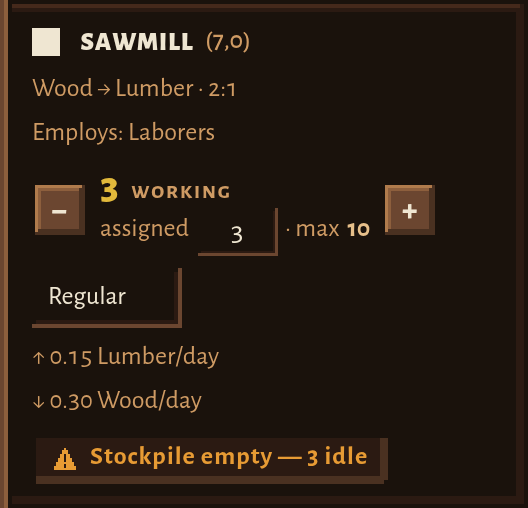
A workshop needs its whole day's worth of raw material in the store before it starts. If it needs one wood and finds only half, it makes nothing that day — not half a plank. And the warning only lights up when the store is completely bare, so a workshop can sit stalled on a few scraps without saying so.
If you want one plan out of all this: after every building finishes, open Workers and give it people. Fill the farm to thirty first and set it to Critical. Before you staff any workshop, check that somebody's green arrow is bigger than its orange one. And keep an eye on that idle number — a villager with nothing to do is a meal you are paying for and getting nothing back.