1What trade is for
Every city you found is good at one or two things and short of the rest. Trade moves what one place has to the place that needs it, and it comes in two kinds. A caravan route is yours: goods leave one of your cities for another — or for a friend's — and nobody pays anybody. A contract is a deal with a neighbour: they list a good for sale, you order it, and your treasury pays them each day it arrives. Start with routes. They are the simplest thing in the game, and the one control that matters is the one most new players skip.
2What a route asks you for
Open Economy › Trade and press New Route. Tap the city the goods will leave from, and a blue strip appears along the bottom of the map with a short form in it. Fill it in, tap the destination, and the route exists.

The resource can be anything the city makes or holds. The daily amount can be a fraction, to two decimal places. Keep at least is the reserve — the stock the sending city refuses to part with — and it gets the next section to itself. Guards get section four.
The game picks the road itself. A share of every load is lost on the way — more over rough ground and foreign land — and if no road is cheap enough the route is refused, so pick a closer destination.
3How do I stop a route eating my own granary?
Every day, a route looks at how much of the resource the sending city has, subtracts your reserve, and ships only what sits above it, up to the daily amount you set. If nothing sits above the reserve, it ships nothing and waits.
Leave the box blank and the reserve is zero. The route keeps shipping until the granary is bare, with no warning. This is how a well-meaning ruler starves a capital: set up a route to feed a struggling colony, forget the box, and feed it out of your own children's mouths.
So fill it in every time. For food, keep a few weeks of what the city eats; for wood and stone, enough for whatever you plan to build next.
Open the city's Trade tab and every route leaving it has a keep ≥ box. A route being held back says so — paused, keeping 40 in reserve. A paused route is not a broken one. It is doing exactly what you told it.
4Who will come for my caravans?
Any army that is not your friend can cut a route. A hostile force that stops on a hex in the middle of your road gets a Disrupt Trade Route button, and an unguarded route is destroyed the moment they press it. You do not need to be at war — a stranger you have never spoken to counts as hostile.
With guards, a raider has to beat them first. If the guards win the route survives, though some of them will not; if they lose, route and guards are gone together. Guards do not make a route safe. They make it expensive to rob, which for most neighbours is the same thing.
Guards come from the sending city's idle people and cost what any soldier costs, with one kindness: a guard's daily wage is half what the same soldier costs in the field. Two spearmen on a route are 0.06 gold a day, paid from the same treasury as your armies — and if that runs dry they desert with the rest. Add or remove them any time with Edit guards on the route's card.
5Is my route actually moving?
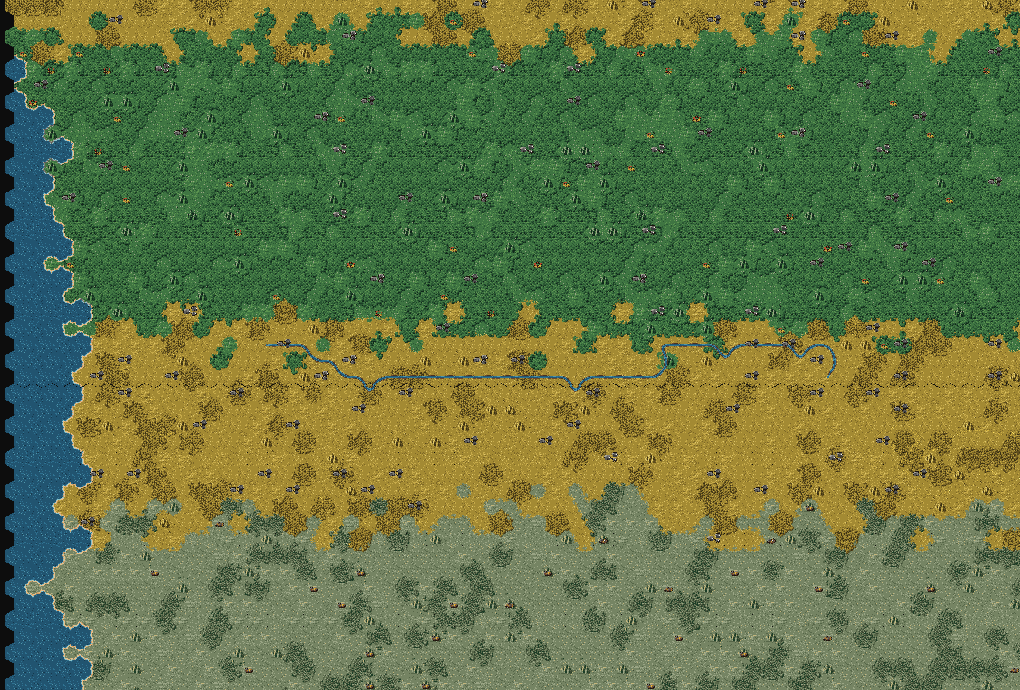
Two places to look. First, the map.

For the numbers, open Economy › Trade › Routes. The three lines at the top are your whole trade at a glance: routes, how much moved at the last shipment, and how many are idle. Below that, every route gets a card in one of two lists.
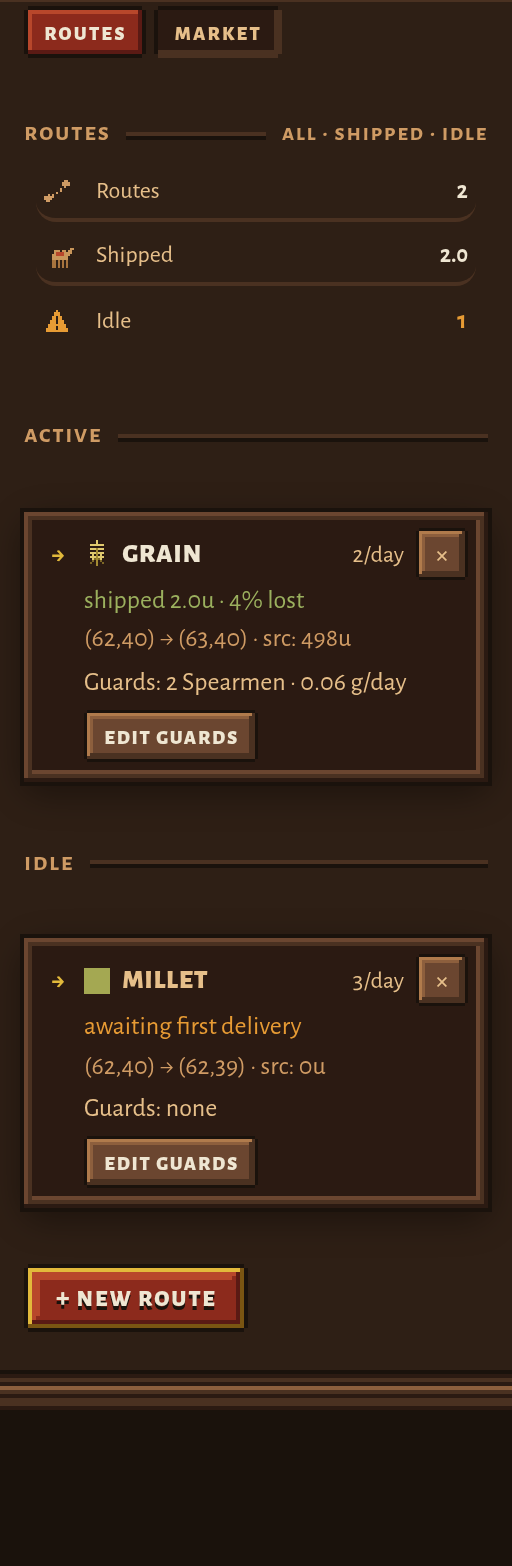
An idle card always says why in a few words. The × deletes the route, and its guards go home.
6Buying from a neighbour
A route only moves what you already own. To get what your land does not produce, you buy it, in Economy › Browse.
Browse stays empty until three things are true, and it ticks each one off for you. You need the discovery Trade Networks. You need a trade treaty with the seller, which you can only offer to a kingdom you have met. And the seller must be within reach of your caravans — a road too rough for a route is too rough for a contract, and a later discovery, Caravan Routes, stretches your reach.
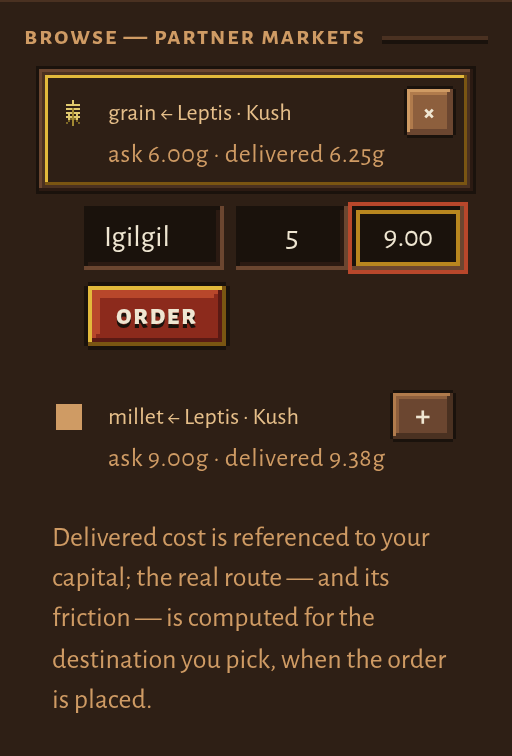
Compare the delivered price, not the ask: you pay for every unit that leaves the seller, and the road loses some on the way. One caveat — the list works that figure out for your capital; send the order somewhere else and the real road is measured when you place it.
The ceiling is your protection. Sellers reprice most days, and the moment their ask climbs above it the contract stops until you raise it or they come down. The suggested number is fine; setting it exactly at the ask is not, because the first small rise stops your deliveries.
Press Order and the contract moves to Imports, where you can change its terms or cancel it; your own sales appear under Exports. If you would rather buy a comfort than make it, the luxuries guide covers when that is the smart choice.
7Why has my contract stopped?
Every contract row carries its state in a few words.
| What the row says | What is going on | What to do |
|---|---|---|
| Active | It shipped yesterday | Nothing |
| Nothing shipped | Nothing moved and nothing is obviously wrong — no stock, or the contract is new | Wait a day or two |
| Suspended — ask above your ceiling | The seller's price has climbed past your limit | Raise the ceiling, or wait |
| Suspended — seller delisted | They took it off sale. No ceiling revives this | Cancel and buy elsewhere |
| Suspended — hostilities | You and the seller are fighting. It resumes if you reconcile; open war ends it | Make peace, or cancel |
| Unaffordable | Your treasury cannot cover one unit at today's ask | Find gold, or cancel |
Unaffordable surprises people. A contract never puts you in debt: each day it ships only what your treasury can pay for, and when that is less than one unit, nothing moves. A kingdom quietly running out of gold gets no warning — just that word, and empty shelves a few days later.
8A route that will not hurt you
Your first route is almost always food from the capital to a new second city. Here is one you can copy straight off the form in section two.
Two grain a day keeps a young colony fed and you will barely notice it leaving. Forty in reserve means the capital always has a few weeks in hand, and the route stops itself before your own people feel it. Two spearmen cost 12 gold and 4 wood once, then 0.06 gold a day — the cheapest insurance in the game.
If you take one thing away, take this. The reserve box is the route. Everything else on the form is a preference; that number is the promise that your own city eats first. Fill it in every time, put a couple of guards on anything that crosses open ground, and let contracts bring what your land cannot grow.