1What a vassal actually is
A vassal is a kingdom that has agreed to answer to you. It keeps its own cities, its own people and its own armies, and it is still played by whoever was playing it. What changes is that it now sends you money, and the world counts the two of you as one nation.
You are the overlord; they are the vassal. It is a lasting treaty like any other, and treaties are public — so the moment somebody swears to you, your rivals know.
A kingdom serves one overlord at a time, and the chain cannot loop back on itself. The road to victory guide explains the four ways of scoring; this one goes deep on the fourth, because it is the one most players never touch.
2How do I get one?
Open the Diplomacy tab, tap the kingdom you have in mind, and its row opens up. In the dropdown at the bottom, pick Vassalage (demand) and press Propose. The word demand is doing real work there: whoever makes the offer becomes the overlord, so this is you telling them to kneel.
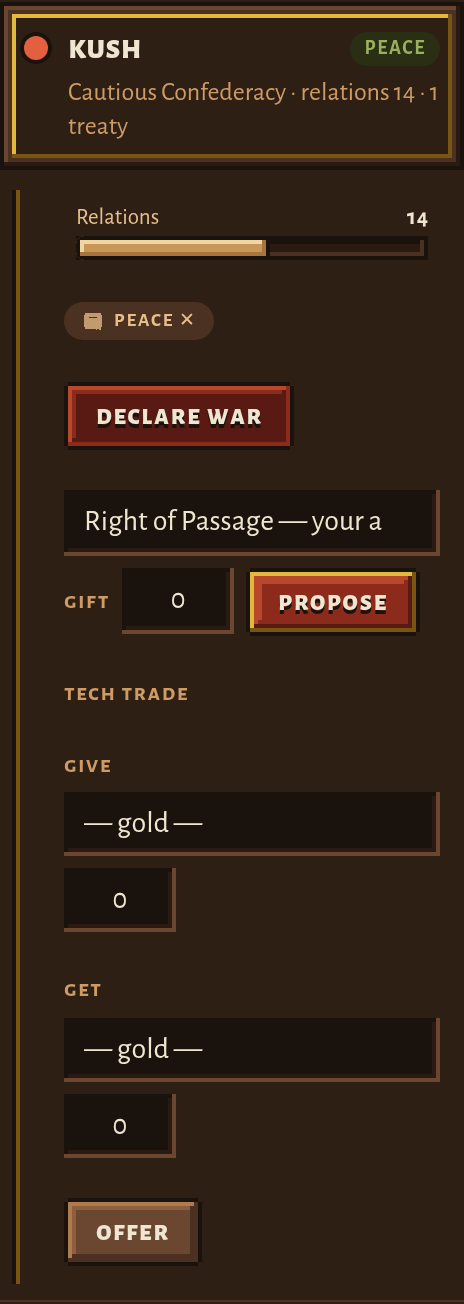
Now the part that saves you a lot of wasted effort. A kingdom run by the game decides this on one question: are you more than twice as strong as it is? Not whether it likes you. Not how large the gift in the box is — a gift buys trade agreements and alliances, and does absolutely nothing here.
Strength is a plain sum: every soldier you have, plus one point for every twenty gold in your treasury. Thirty soldiers and six hundred gold come to sixty. A neighbour with twenty-five soldiers and two hundred gold comes to thirty-five — more than half of sixty, so they refuse. Raise ten more soldiers and the answer changes.
There is a second door, in theory: a kingdom that likes you enormously kneels out of loyalty. Ignore it. Warmth between kingdoms settles around forty even after a lifetime of treaties, and this door needs eighty. Vassals are taken by weight, not by charm.
Being refused is not free — relations fall a little each time you ask and are turned down. Build the strength first, then ask once.
Strength counts soldiers, not cities. A kingdom that has just lost a war has lost its armies, which means its strength has collapsed even if its land has not. That is the moment the demand goes through — and signing it ends the war between you on the spot. You get the oath instead of the siege, and you keep the army you would have spent taking the place.
3What the oath is worth
Start with the score, because it is why most players eventually go looking for a vassal.
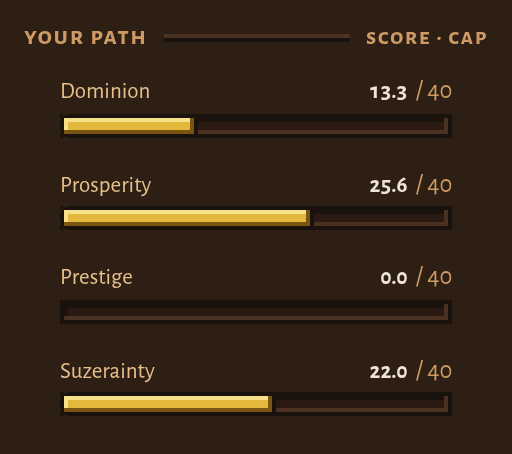
Your standing is built from four quarters of forty. The fourth is Suzerainty, and it is the only one nobody can take from you by growing. A live vassal is worth 14, and a vassal whose tribute has come in is worth 8 more — so an ordinary, paying vassal is 22 points.
On worlds created from ruleset 34 on, those 8 only count while gold is really arriving: some tribute must have reached you in the last thirty days. A vassal too broke to pay anything leaves you on 14, and a brand-new oath sits on 14 until its first payment lands thirty days later. On older worlds the full 22 starts the day the oath is sworn, paid or not.
Then the money. Every thirty days, a fifth of everything in your vassal's treasury moves into yours. Not a fifth of their income — a fifth of the pile. A vassal sitting on 500 gold hands you 100 and keeps 400.

And then the quieter things, which matter more than they look.
| What changes | For you, the overlord | For them, the vassal |
|---|---|---|
| Fighting | Neither of you can raise a hand against the other. Any war between you ends the day the oath is sworn | |
| Armies | Both sides may march across the other's land freely | |
| Trade | No border toll either way — routes between you carry the same as routes at home | |
| Caravans | Neither of you can cut the other's trade routes | |
| Gold | A fifth of their treasury, every 30 days | Pays it |
| Score | Up to 22 points, and their score joins yours | Keeps its own score entirely |
That row about armies is easy to skim past. A vassalage is a road through a kingdom. If your neighbour's land sits between you and the rival you actually care about, one oath turns a wall into a corridor.
4What it does not buy you
Four disappointments, all worth knowing before you plan around an oath rather than after.
Your vassal will not come when you are attacked. That is what an alliance does; vassalage does not. Nobody marches to anybody's rescue here. If you want a neighbour who fights for you, sign an alliance with somebody else and take the oath from this one.
Their land is not your land. Territory is counted by who owns it, and your vassal still owns theirs. An oath adds nothing at all to the quarter of your score that comes from holding ground.
Their vassals are not your vassals. If your vassal takes an oath of its own, that kingdom answers to them, not to you. Only the lords who kneel to you directly count. Three separate lords sworn to you beat one lord with a long tail behind him, every time.
Either of you can walk away. A vassalage is breakable like any other treaty, by either side, and the cost is a sharp drop in relations — nothing more. A vassal who has quietly rebuilt its army can simply stop being one. If your score leans on two oaths, watch the two kingdoms who swore them.
5Two vassals fill the quarter
Suzerainty stops at forty like every other quarter. One paying vassal is 22. Two are 44, which is over the line, so two vassals fill that whole quarter of your score and a third adds nothing to it.
Set that against what the rest of the game asks. Forty points of territory means out-holding every other kingdom on the map. Forty points of great works means a finished Monument and most of the culture your scholars can find. Forty points of Suzerainty means two conversations, held at the right moment with the right weakened neighbour.
One condition is attached, and it is a trap for conquerors. A vassal who holds no land is worth nothing. The treaty does not end when their last city falls — the row stays, the name stays — but the points vanish, whether you took the city or somebody else did. Beat them into kneeling, then leave them standing.
6The Nation road to the crown
There are two ways to reach the bar. On your own, you need 100 points. As a nation — you plus the lords sworn directly to you, each of their full scores added to yours — you need 115. Either way you then have to stay there for twenty days without slipping once.
The moment you take a vassal, a Nation line appears on your Victory tab listing the members and the total. That line is your second route to a crown, and it is often the nearer one, because it counts the whole of a vassal's score rather than the 22 the oath is worth to you. A vassal with a Monument and a decent realm might be carrying sixty points of its own.
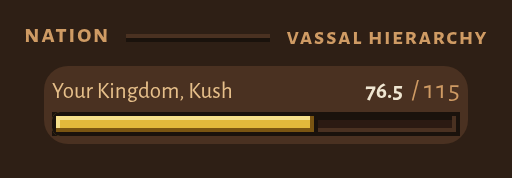
Fifteen more points for a partner who is bringing sixty is a good trade, and it is why an ordinary-looking kingdom with one loyal vassal will often crown before the largest empire on the map does.
Both roads are watched at once. If your own score crosses 100 you start a count; if your nation crosses 115 you start a second one; the first to reach twenty days is the one that crowns you. And in a world that ends — a Finite world — that same completed wait ends the world outright, with your name on it.
7When somebody demands your oath
It will happen. A warlike neighbour at twice your strength, or an expanding one at half again your strength, will make the same demand of you, and you either accept or refuse.
You get some protection first. A kingdom run by the game will not make that demand of a player who joined in the last hundred days or who holds fewer than three cities. If a demand arrives, it means you are neither any more.
Refusing costs a little goodwill and nothing else. Accepting is not surrender. You keep every city and every soldier, the war between you ends, their land opens to your armies, and your caravans stop paying tolls at their border. You pay a fifth of your treasury every thirty days — which, if your treasury is nearly empty, is nearly nothing.
What you lose is the top of the table: your score still counts, but towards their nation. You can still take oaths of your own from kingdoms weaker than you, so a middle lord with lords beneath him is a perfectly legal shape.
It is a good deal when you are losing and a poor one when you are not. Take the oath to survive a war you cannot win, rebuild behind it, and break it when your armies say you can.
8Keeping the crown once it is on
Complete the twenty days in a world that carries on and you are crowned. A banner goes up with your name and the day your reign began, and your reign is recorded in the Dynasty list whatever happens next.
You keep the crown until your own score drops below 80. Note own. If you crowned on the strength of your nation, the crown is held by your personal score alone, and a nation-path ruler's personal score is often well under eighty. That makes a crown won through vassals a genuinely fragile thing: it lasts as long as the nation keeps qualifying, and the day a vassal is eliminated, or breaks its oath, or simply falls apart, the nation stops clearing the bar and the crown comes off.
The reverse is what makes the whole path worth walking. A rival passing 100 does not take your crown. There is no re-election. While you keep qualifying you simply keep it, however well anybody else is doing. The only way it changes hands is if the wearer falls below eighty first.
So if somebody else is reigning, do not chase their number. Look at what is holding them up. If it is a nation, the weakest part of it is not the overlord at all — it is the vassal. Take that kingdom's land, or offer that kingdom a better deal, and the crown falls off a ruler you never touched.
If you take one thing away, take this. Two oaths are a quarter of a crown, and they are the quarter nobody is competing with you for. Everyone else is fighting over land and gold. Go and find the neighbour who has just lost a war, ask once, and leave them their cities.