1What an army actually is
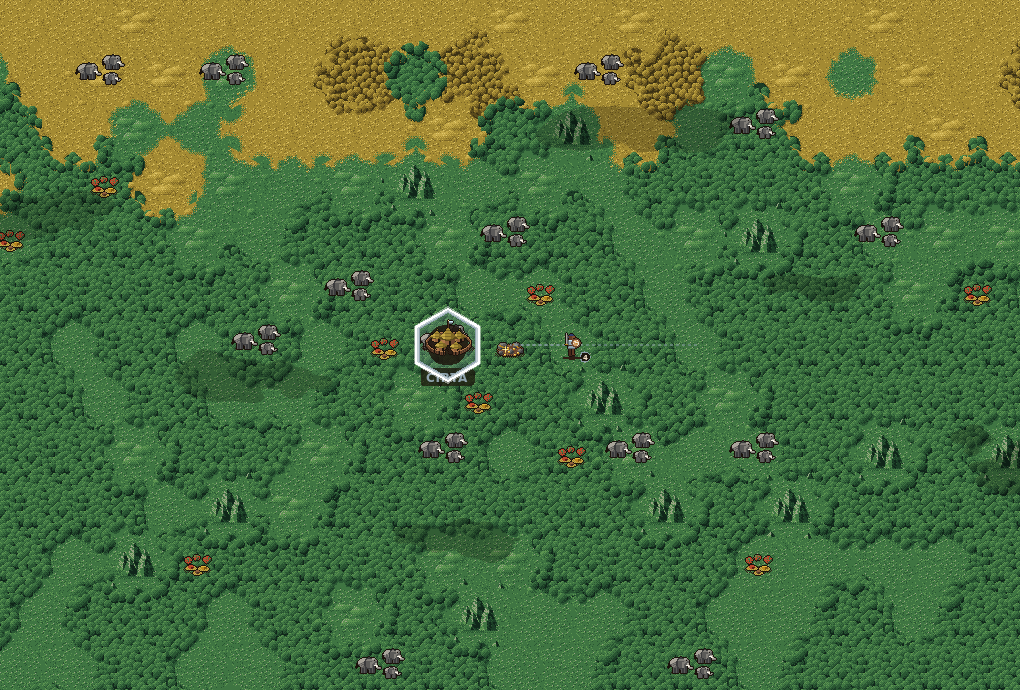
An army is a group of your people standing on one hex of the map. That is the whole of it. There is no separate barracks screen, no roster of named generals — just a stack of soldiers, on a tile, doing one of three things.
It is idle (standing about), marching (walking towards somewhere you picked), or occupying (camped on a rival's land, waiting for it to fall to you). You will see that word on the army's line in the Military tab, and almost everything here comes down to which of the three it is.
One more thing before you spend anything. One soldier is one person. While he is carrying a spear he is not farming, building or selling. An army is not something you add to your kingdom; it is something you carve out of it.
2Who becomes a soldier?
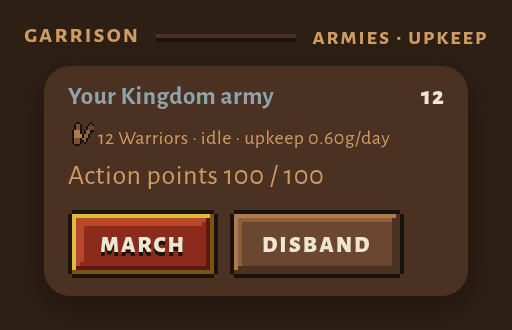
Select one of your own cities and open the Military tab. Near the bottom is a small form called Draft Troops: pick who they come from, pick what kind of soldier, type a number, press Draft.
The people come from your villagers — the townsfolk who have not been given a job yet. You cannot take a farmer off a field or a scholar off a book and hand him a spear; you recruit only from the ones standing idle. If your villager count is low, your army is capped no matter how much gold you are sitting on. The staffing guide covers the other half of that same pool.
Drafting takes three things at once: gold from your treasury, people from that city's villagers, and materials from that city's own store — wood, leather or steel, depending on the unit. The materials must be in that city, not somewhere else in your kingdom. If any one of the three falls short the draft is refused, nothing is spent, and a line beside the form tells you which one it was. A city under occupation cannot draft at all.
You can undo a draft. Disband an army standing on your own land and every soldier walks back into the class he came from — no gold back, but no people lost either. It only works on your own territory, and not while that city is being besieged.
3Which soldiers should I buy?
Three kinds are open to you from the first day. Everything else is behind research, and you will not see it in the dropdown until you have found it.
| Soldier | Costs | Attack | Defence | What makes him different |
|---|---|---|---|---|
| Warrior | 5 gold + 1 wood | 2 | 3 | Cheap and hard to shift. Your wall. |
| Archer | 8 gold + 2 wood | 3 | 1 | Shoots before the fighting starts. Dies fast if reached. |
| Cavalry | 20 gold + 3 leather | 5 | 2 | Walks twice as fast, and hits half again as hard on flat ground. |
The honest advice for a new ruler is: mostly warriors, a handful of archers. Twenty warriors cost 100 gold and 20 wood and will beat almost anything an early neighbour can field. Cavalry are four times a warrior's price and eat leather you probably need elsewhere — they earn their keep as a fast reaction force on open ground, not as the body of an army.
Research opens better soldiers later: swordsmen, anti-cavalry spearmen and impi, war elephants, siege engines built for breaking walls, and heavy horse. A scout is worth knowing about even though he barely fights — he is fast and he sees further, so an army with one in it lifts more of the map as it goes.
Buildings make drafting cheaper rather than better. A Barracks takes a tenth off the gold cost of everything you raise in that city; a War College takes a fifth.
4The bill that arrives every day
This is the part that ruins more kingdoms than any battle does.
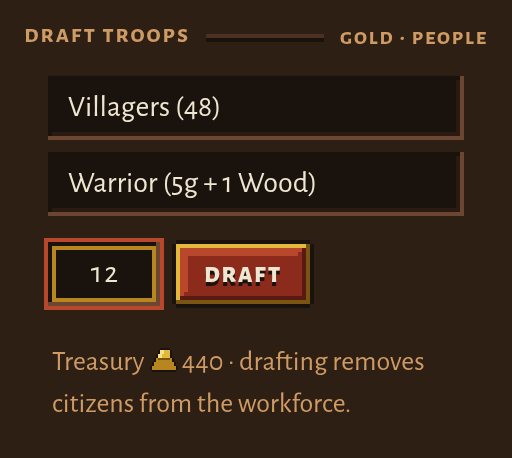
Every soldier draws pay from your treasury every single day, for as long as he exists. A warrior is 0.05 gold a day. That sounds like nothing until you have raised sixty of them, which is three gold a day, forever, whether they are fighting or asleep. An archer is 0.08, a cavalryman 0.20. The army's line in the Military tab prints its total for you.
Now the bad day. Each evening the game adds up what all your armies are owed and takes it from your treasury in one go. If the treasury cannot cover the whole amount, your soldiers start walking home. Every army you own loses about one man in twenty that day, and again tomorrow, until the money is there. Nobody is returned to your cities — deserters simply leave.
If an army that is occupying somebody's land deserts down to nothing, the occupation ends with it and the territory goes straight back to work for its owner. Running out of gold does not merely pause a war — it can hand back a city you were one day from taking.
So treat a headcount as a wage bill. Before you raise fifty soldiers, look at what your treasury earns in a day and ask whether it can carry them for a season. An army you cannot pay is worse than no army: it costs you the gold and the people, and then melts anyway.
5How long does a march take?
Press March on an army, then click the hex you want it to reach. Before you confirm, the game draws the route it will take and tells you how many days it expects to need.
Two things set that number. The first is the speed of your slowest soldier — an army of cavalry and warriors together moves at the warrior's pace, because the horses wait for the men. The second is the ground. Every hex costs a certain amount to walk into:
| Ground | Days to enter one hex |
|---|---|
| Flatlands | 1 |
| Forest | 1.5 |
| Hills or desert | 2 |
| Mountains | 3 |
So a warrior crossing four hexes of grass arrives on the fourth day; the same march through mountains takes twelve. The route the game picks is the quickest, not the shortest, so it will happily walk you round a mountain rather than over it.
Armies see as they walk: every hex one enters is revealed along with the ring around it, which is how most of the map gets found. And if a neighbour has granted you Right of Passage, your armies move a quarter faster while they are on his land.
On newer worlds every army also carries a tank of 100 action points. Walking into a hex spends some of it, and rough ground costs more. Time still works exactly as above. Action points are a second limit on top of it.
| Ground | Action points to enter one hex |
|---|---|
| Flatlands | 5 |
| Forest | 8 |
| Hills or desert | 10 |
| Mountains | 15 |
So a full tank carries an army about twenty hexes over open grass, or ten through hills. Pick a hex your army cannot afford to reach and the game says no, and tells you what the march would cost against what the army has. While you are choosing, the dashed line turns red at the point where the army would run out. Stop there, or anywhere before it.
The tank refills only while the army is standing still: 10 a day in one of your own cities, 8 a day in a city of a kingdom you have an Alliance or a Vassalage with, and 5 a day anywhere else. A marching army refills nothing. Tap any hex and the Territory tab shows its Movement Cost; open the Military tab and each of your armies shows how full its tank is and how long until it is full again.
What that means for you: a long march leaves an army tired and a long way from home. Until it has rested it cannot chase anyone or run from them, and a defender who has been sitting still can. Plan long campaigns through your own cities and your allies'.
6Stopping, and changing your mind
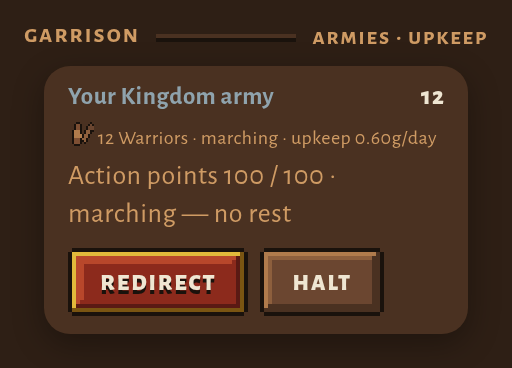
A marching army used to be a decision you could not take back. It is not any more. Click one that is on the road and you get two buttons instead of March.
Redirect gives you the destination picker again and sends the army somewhere else from wherever it is standing right now. The part-finished step it had banked carries over into the new route, so nothing already walked is wasted.
Halt stops it where it stands, as an ordinary idle army with no destination. Halting throws away that banked part-day, so halt-then-march is always a little slower than simply redirecting. If you already know where you want it instead, use Redirect.
On worlds with action points, neither button spends any. A halted army keeps whatever is left in its tank, and a redirect is priced from where the army is standing now: if it cannot afford the new route from there, the game says so and the old order stands.
One army you cannot halt: one that is occupying. A besieging army is committed. If you want it off that tile you march it off, and you lose the siege.
Halting an army that has already arrived is not an error — it quietly does nothing. That matters, because on a live world your screen is a few seconds behind the truth and an army you thought was walking may already be home.
7What happens when two armies meet
You do not fight battles. You decide where your army goes, and if somebody hostile is standing there the fight resolves on its own and you are told the result. The order it happens in is worth knowing, because it is what makes an army worth building rather than merely large.
Archers shoot first. Before anything else the bowmen on both sides thin the other out — each one accounts for about a fifth of a man before the lines meet. A handful of archers behind your warriors is worth more than the same gold spent on more warriors.
Then the two sides are weighed. Each soldier contributes his attack value. Cavalry get half again on flat ground. Siege engines hit much harder against a city with walls. Certain units brace against horsemen and fight on their much better defence number instead.
Then the defender's advantages are added — but only if the defender owns the hex the fight is on. Your own hills are worth a quarter more, your own forest a fifth, and fortifications stack on top: a Palisade Wall is another quarter, a Grand Citadel doubles you outright.
Then fortune nudges each side by as much as a tenth. It is small, but a close fight is genuinely a coin toss, so never march out on a margin that thin. If the two sides come out exactly level, the defender wins.
The loser is wrecked — about seven men in ten. Survivors run to a neighbouring hex their own ruler holds, and if there is no such hex they are finished where they stand. The winner pays too, in proportion to how hard the fight was: a comfortable win costs very little, a narrow one can cost half an army.
A settler party carries people and goods and has no fighting value at all. Settlers never take casualties in the exchange — but if the army escorting them loses, the whole party and everything it was carrying is gone. Never send settlers anywhere you would not send an escort.
One last thing about stacks. Two hostile armies sitting on the same hex do not stare at each other — they fight once a day, every day, until one of them is gone. A quiet border can turn into a daily battle the moment a treaty lapses.
8Taking a city, and keeping your own
March an army onto land somebody else owns and it stops there and settles in. That is an occupation — a siege. The army's line starts counting down the days until the territory becomes yours.
The wait is ten days as standard, and the defender can stretch it: every Watchtower adds five, and a Watchtower upgraded to a Fortress adds five as well as making the garrison much harder to beat. Those days are the defender's best chance, because a siege is not safe. If anyone beats your besieging army on that tile, the occupation breaks instantly and the count starts again from the beginning.
While a city is occupied it is dead weight for its owner. It produces nothing and pays no tax, and any settlers it was preparing stop being prepared. That alone is often reason enough to besiege somewhere you have no intention of keeping.
When the count reaches zero the territory changes hands whole. The people stay, the buildings stay, whatever was in the storehouse stays — you are taking a working city, not empty ground. Any price caps the old ruler had promised are cleared, because his promises are not yours to pay. On worlds created from ruleset 35 on, his market instructions go too — the asking prices he had set on goods for sale, and the export floors he kept back from selling — so you start that city's market with a clean slate.
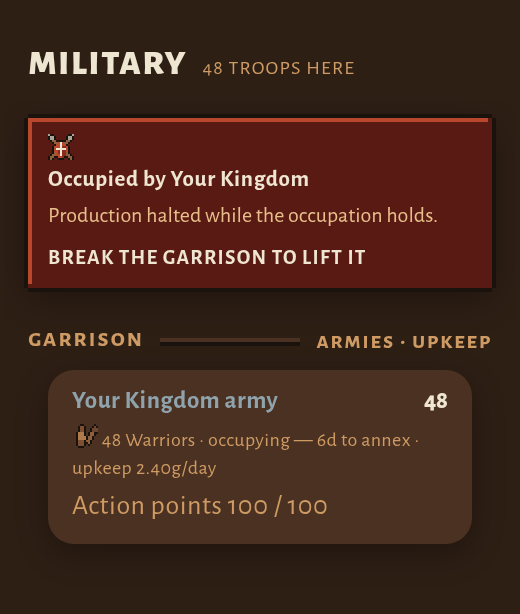
Which tells you how to defend. A wall, a watchtower and a garrison on your own hills are worth far more than the same gold spent on soldiers in the field, because those bonuses only count when you own the ground. Defending is cheaper than attacking here, and that is on purpose.
And before you march on anyone, read section 4 again. Conquest is not won by the army that wins the battle. It is won by the one that can still afford to be standing there ten days later.